Lubomirski Palace
Articles
Let’s get to know Ukraine!

Lubomirski Palace

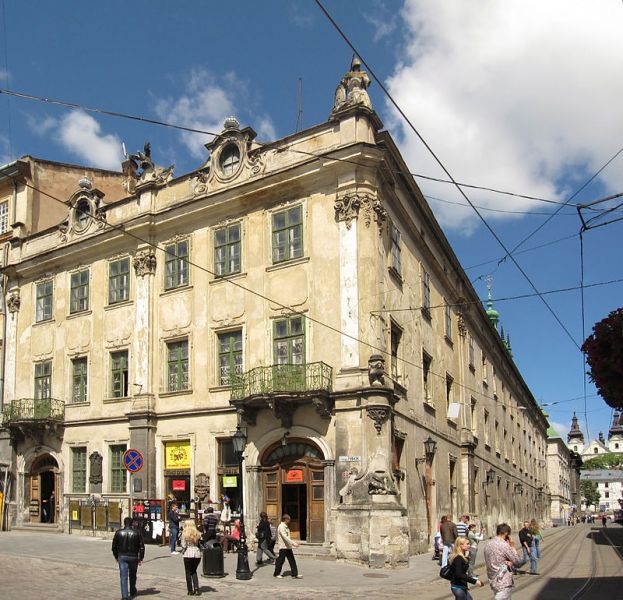
justify; ">In the center of the historic city of Lviv there is the Lubomirski Palace, in the house at number 10. Three facades of the structure overlooking the Rynok Square, the streets of Russkaya and Fedorova.

The palace is also called the house of the eagle. At the end of the 18th century, there was the residence of the Austrian governors of Galicia. In the late 19th and early 20th centuries various cultural and educational institutions were in the house, which were attended by many outstanding figures of Ukrainian culture. Gothic masonry and basements, where beer houses were previously located, were built in the 17th century. This is shown by a cartouche in 1695 on a carved stone portal, which opens onto Fedorov Street.

To date, the Palace of the Museum of Ethnography and art is located, where rare exhibits are displayed, which represent the decorative and visual arts of Europe 16th - early 20th centuries. You will see a unique collection of furniture, porcelain and faience. And on the third floor you will have the opportunity to get acquainted with the Ukrainian art of the 18-19 centuries. In addition, the interior is also impressive with its decoration, especially the fireplaces designed by Sebastian Fesinger.
Дворец Любомирских

In 1760, Prince Stanisław Lubomirski purchased a small stone building and several other Gothic-style structures from Prince Jan Sapiga, and then combined them into a single complex that now bears his name—the Lubomirski Palace. In 1763, under the design of architect Jan de Witte, major renovations were carried out. Many renowned architects and sculptors participated in its construction. The palace is built in the Baroque style, with a facade divided into sections by pilasters and cornices, and windows featuring ornate frames. The attic is decorated with dormers, cartouches, and a statue of an eagle. Additionally, military motifs can be observed throughout the building.

The palace is also known as "the House of the Eagle." In the late 18th century, it served as the residence of the Austrian governors of Galicia. During the late 19th and early 20th centuries, various cultural and educational institutions were located there, and many prominent figures in Ukrainian culture attended these establishments. The Gothic-style construction, including the underground cellars that once housed breweries, was built in the 17th century. This is evidenced by a cartouche dating from 1695 on the stone portal facing Fedorova Street.

Today, the Lubomirski Palace houses the Museum of Ethnography and Arts and Crafts, which displays rare artifacts depicting the decorative arts of Europe from the 16th to the early 20th centuries. Visitors can admire a unique collection of furniture, porcelain, and pottery. On the third floor, Ukrainian art from the 18th and 19th centuries is on display. The interior design is also noteworthy, especially the beautiful fireplaces designed by Sebastian Fesinger.
The Lubomirski Palace

Recommended articles

Find the Best Professionals for Your Project

Expert repair, construction, and renovation specialists ready to help you right now