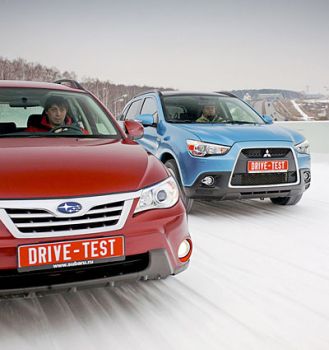
A huge difference.
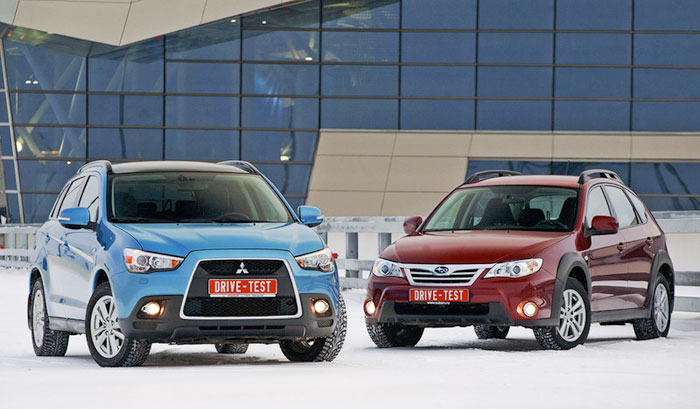
Are their capabilities truly equal? Both crossover models are equipped with 2.0-liter gasoline engines (both delivering 150 horsepower), automatic transmissions, and all-wheel-drive systems. The difference lies in the fact that the ASX’s inline engine is paired with a continuously variable transmission, while the Impreza’s opposed-engine setup is combined with a four-speed “hydromechanical” transmission. The base prices of these two models are fairly similar: ranging from 220,000 to 270,000 hryvnia for the Impreza with an automatic transmission, and from 190,000 to around 300,000 hryvnia for the ASX, depending on the configuration.
Specific Details
The seats in the Mitsubishi are positioned quite high, which requires passengers to sit with their knees bent significantly. This may not be convenient for everyone; during long drives, the legs get tired, but there’s nowhere to stretch them out. The Impreza doesn’t have this issue – the seating position allows the legs to remain almost straight, even during extended journeys. However, in urban traffic, the driver of the Mitsubishi has a better view due to its higher seat height. Nevertheless, the Subaru also offers good visibility, thanks to its thin body panels and large mirrors.
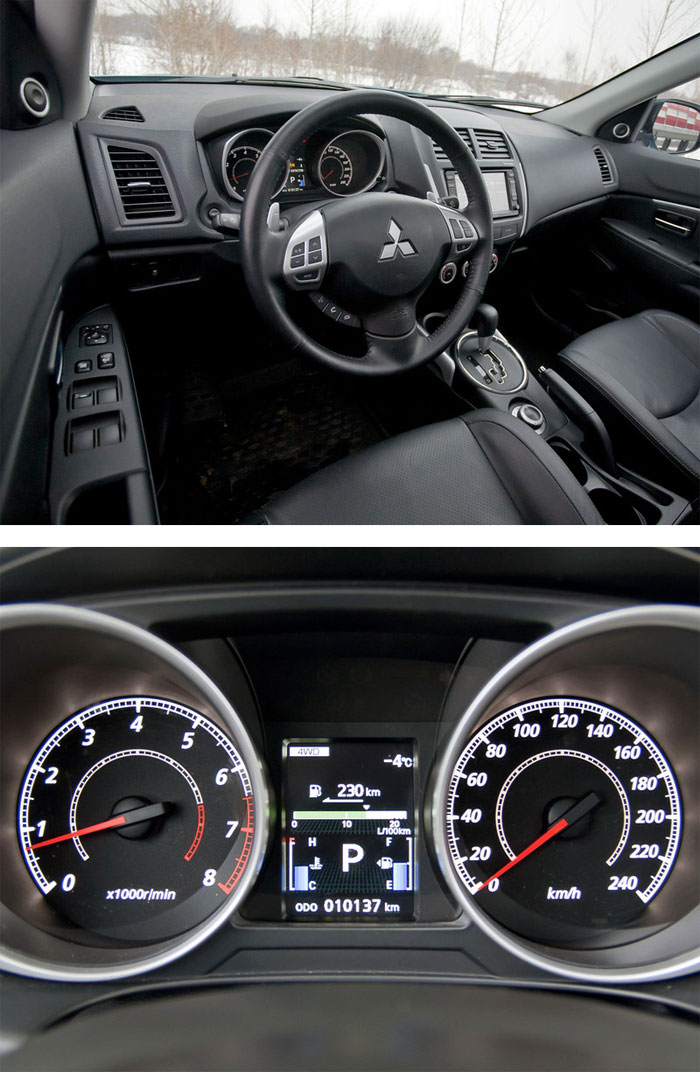
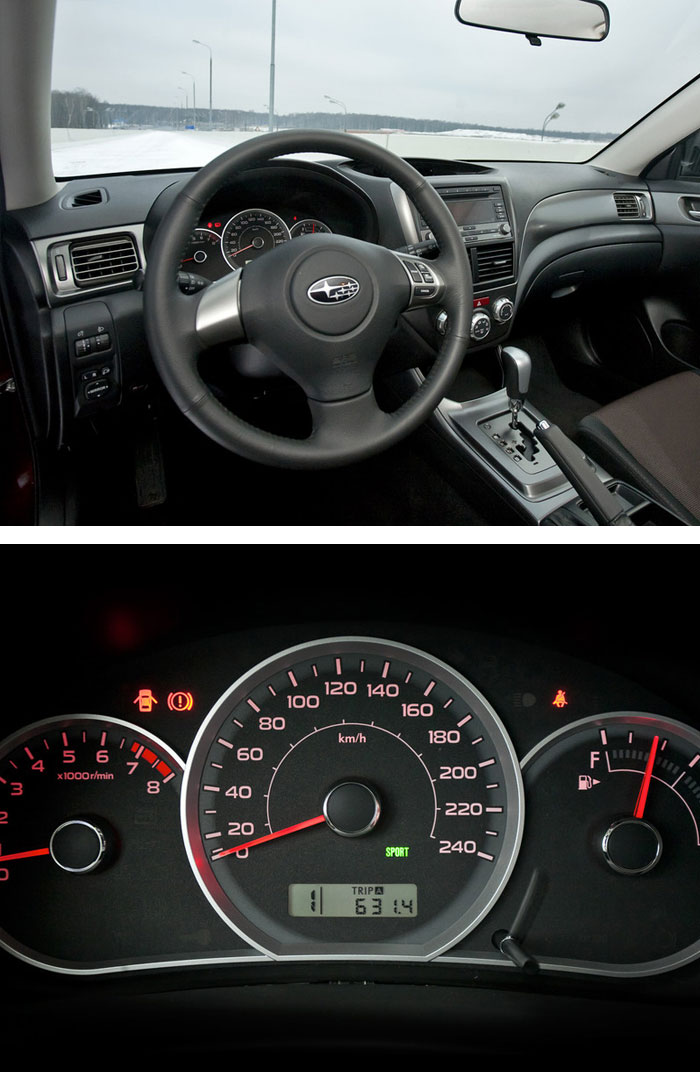
When it comes to interior design, the Impreza doesn’t have much to offer in comparison to its competitor. The driver is surrounded by hard plastic materials, and the design of the front dashboard seems somewhat outdated. As for additional comforts, there are only a few controls for the audio system on the steering wheel – and, frankly, the sound quality isn’t very good either... In contrast, the Mitsubishi’s interior feels much more premium: it looks and feels pleasant to use. I particularly liked the soft padding on the door panels; one couldn’t help but touch them whenever the opportunity arose. There are also many other convenient features, such as navigation systems, rear-view cameras, and a panoramic sunroof – things that the Subaru doesn’t even offer as optional extras.
In terms of space for rear passengers, both models are comparable. The Subaru’s soft backseat is more comfortable, but the Mitsubishi’s seats, being raised slightly above the floor, result in a seating position that’s too close to vertical. However, due to the Subaru’s longer wheelbase (2,670 mm compared to the Impreza’s 2,615 mm), there’s more legroom available. With its higher front seats, passengers in the Mitsubishi can almost stretch their legs all the way! Therefore, people of different heights will find it easier to sit comfortably in the Mitsubishi.
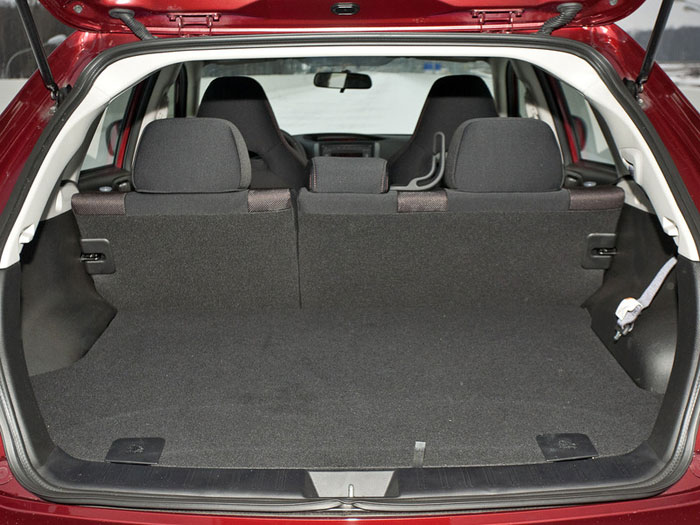
The ASX also has an advantage when it comes to cargo space. Due to its lower height, the Impreza’s trunk is rather limited, even by golf-class standards – moreover, protrusions covering the rear suspension mounts further reduce its capacity. In contrast, the Subaru’s floor has been raised to accommodate a full-size spare tire underneath. Although the spare tire in the Subaru is made of steel, the Mitsubishi driver can still use it if the original tire gets punctured. The ASX offers significantly more storage space, although its trunk shape isn’t exactly ideal.
As soon as we hit the road, it became clear that the Impreza XV was at a disadvantage in terms of aerodynamic noise. The Mitsubishi’s tall body design generated considerable wind noise, and its insulation against road noises wasn’t very effective. I could clearly hear the howling of the wind around the vehicle’s shape, as well as the rumble of the tires and the sound of the engine running at high revs.
Inside the Impreza, it was much quieter, despite the noticeable transmission noise. The sound of the opposed-engine configuration was lower in volume and more pleasant to listen to. Wind noise only started to become noticeable at higher speeds. However, the Impreza handled the road much better than the ASX – its suspension effectively smoothed out all unevenities without causing any excessive body roll. The steering provided a firm and precise response, with a clear “zero” point. In contrast, the Mitsubishi’s steering system offered less feedback; although it didn’t cause serious handling problems, it was somewhat noisy and felt less responsive compared to the Impreza. Subjectively, the Mitsubishi felt more unstable and less suitable for aggressive driving at high speeds.
Both vehicles’ engines were equally powerful and had similar torque outputs. Nevertheless, the Subaru’s opposed-engine configuration provided better low-speed performance, while the Mitsubishi’s engine performed more efficiently in the mid-range speed range. Ultimately, it was the transmissions that determined the overall driving experience. The ASX’s continuously variable transmission kept the engine constantly active, even at the expense of some audio discomfort. The blue-colored ASX accelerated more smoothly, especially thanks to its dampened accelerator pedal; its engine was most efficient at medium speeds.
According to the specifications, the Subaru lagged behind the Mitsubishi by about 0.4 seconds in accelerating from 0 to 100 km/h. In reality, the difference felt much greater. The Impreza’s old four-speed automatic transmission performed poorly, especially in sporty driving modes; its response to accelerator input was sluggish and unreliable. Moreover, shifting between first and second gear caused uncomfortable jolts.
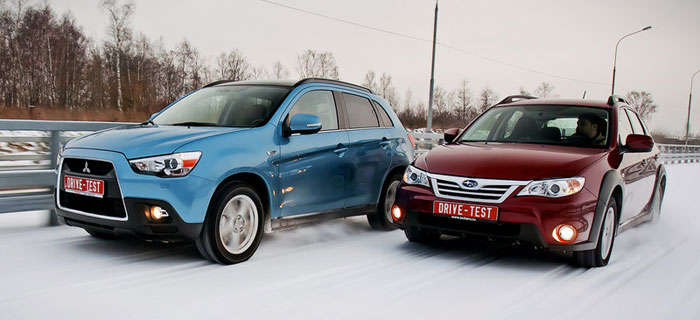
This time, we decided not to attempt any off-road testing. Instead, we took both vehicles on a snowy and icy road, hoping that the Impreza would at least manage to hold its own in such conditions. Unfortunately, the Subaru’s all-wheel-drive system didn’t perform well – it lacked a differential between the front and rear axles, and the torque distribution to the rear wheels was controlled by an electronically operated clutch. As a result, the vehicle struggled to maintain traction on slippery surfaces.
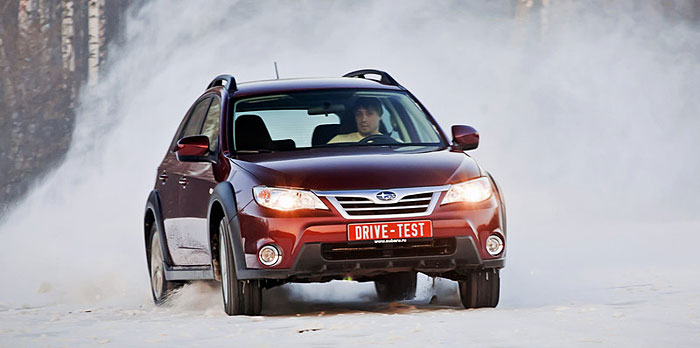
The car would suddenly start sliding without any warning, and it was impossible to stop it simply by releasing the accelerator pedal. Driving on ice requires precise control; the Subaru needs clear and direct commands from the driver. Adjusting the vehicle’s trajectory in a slippery turn is easier done by turning the steering wheel sharply rather than adjusting the throttle. Unfortunately, the automatic transmission often failed to maintain the selected gear, leaving the driver without any traction. On ice, the power steering also lost its effectiveness completely, making it difficult to control the direction of the vehicle.
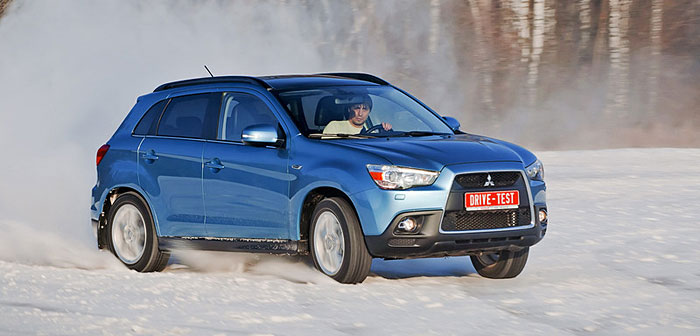
The Mitsubishi’s power steering system maintained a certain level of assistance even on surfaces with low traction, which gave the ASX better control during slippery conditions. Additionally, the continuously variable transmission ensured that the drive wheels were always in a position similar to that of first gear. Although the ASX moved slowly when accelerating, it responded very quickly to changes in throttle input. With the rear-wheel-clutch system locked, the vehicle could still be controlled effectively by adjusting the throttle. At one point, I even stopped turning the steering wheel and simply continued driving in circles, using only the braking force to control the vehicle’s trajectory.
We can clearly conclude that the Mitsubishi outperformed the Subaru thanks to its superior features: comfortable seats, a powerful engine, and a stable suspension system. However, these advantages weren’t enough to compensate for the Impreza’s limited cargo space, outdated transmission, and poor performance in difficult driving conditions. Perhaps things would have been different if we had been testing the Impreza XV with a traditional manual transmission and a differential. But, ultimately, a golf-class hatchback, no matter how well-equipped, still has a hard time competing with dedicated crossover vehicles. The Mitsubishi ASX isn’t perfect either – it has an attractive design and a comfortable interior, but its driving performance is somewhat unstable. Nevertheless, in this case, being successful doesn’t necessarily require perfection.