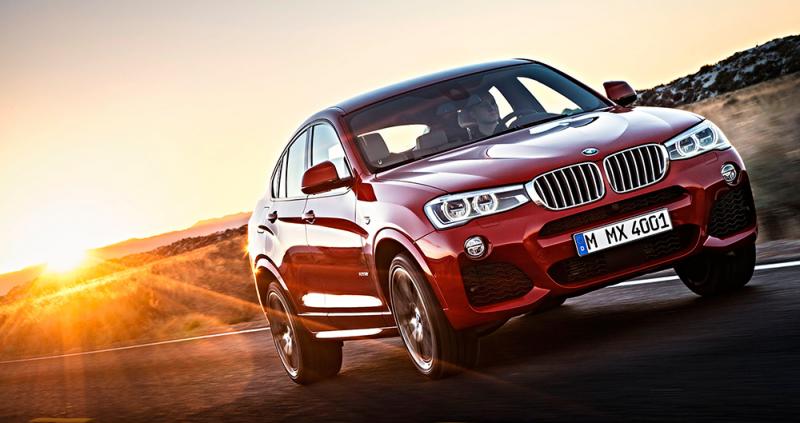
The Germans developed the concept of a coupe-crossover based on the BMW X4.
It’s hard to say. After all, the compact BMW X4 lacks that imposing, stylish, and expensive image that made the BMW X6 so desirable and popular.

The new model is based on the same architecture as the larger coupe-crossover. For the X6, BMW used the platform and powertrain from the X5, then covered it with a low-profile body with a sloping roof. The X4 follows the same approach, but it is actually built on the basis of the BMW X3. The length of the X4 is 4,671 mm, which is 14 mm longer than that of the X3. However, the X4 is 36 mm lower in height, at 1,624 mm. Its width and wheelbase remain unchanged, at 1,881 mm and 2,810 mm respectively. It is also worth noting that the three-seater rear seat can be folded in a 40:20:40 ratio, and the trunk capacity ranges from 500 to 1,400 liters (compared to 550–1,600 liters in the X3).

However, in order to achieve a more sporty driving experience, some of the practical features of the BMW X3 have been sacrificed. For example, both the driver and the front passenger sit 20 mm lower than in the X3, while passengers in the second row are seated 28 mm lower. Comfort has likely also suffered as a result. According to BMW, the suspension has been made stiffer and more rigid by adjusting the damping elements. All versions of the X4 come standard with all-wheel-drive technology (xDrive), a traction control system, and a steering system with progressive characteristics. For those seeking even more performance, there is the M Package, which includes an aerodynamic kit with 18- or 20-inch wheels, as well as a lowered suspension.

The donor shared the engines from the BMW X4, but its range does not include the 143-horsepower turbocharged diesel engine found in the X3. The least powerful diesel option is a 190-horsepower unit with 400 N·m of torque, which, when paired with an eight-speed automatic transmission (there is also a six-speed manual version), enables the xDrive20d model to reach 100 km/h in just 8 seconds. For comparison, the X3 with the same engine takes 8.1 seconds to achieve this speed. Next up is the xDrive30d model, which is equipped with a 3.0-liter turbocharged diesel engine that generates 258 horsepower and 560 N·m of torque. This version of the X4 accelerates to 100 km/h in 5.8 seconds, which is 0.1 second faster than the corresponding X3 model. Finally, at the top of the range is the X4 xDrive35i, powered by a 3.0-liter twin-turbocharged six-cylinder engine that delivers 313 horsepower and 630 N·m of torque. This version accelerates to 100 km/h in a mere 5.2 seconds (compared to the X3’s 5.3 seconds). Both the xDrive30d and xDrive35d models are only available with automatic transmissions.

There are also three gasoline engines available, all of which are turbocharged and are exclusively paired with automatic transmissions. The base xDrive20i model is equipped with a 2.0-liter four-cylinder engine that has been tuned to produce 245 horsepower and 350 N·m of torque. This engine enables the car to reach 100 km/h in 8.1 seconds (the X3 takes 8.2 seconds). The same two-liter engine is also used in the xDrive28i model, but it has been enhanced to produce 245 horsepower and 350 N·m of torque, allowing it to accelerate from 0 to 100 km/h in a respectable 6.4 seconds (the X3 takes 6.5 seconds). The most powerful gasoline engine is installed in the X4 xDrive35i model; it is a 3.0-liter inline six-cylinder engine that generates 306 horsepower and 400 N·m of torque. This engine enables the car to reach 100 km/h in just 5.5 seconds (the X3 takes 5.6 seconds). It should be noted that the curb weight of the X4 models varies depending on the version, but it is generally the same as or slightly higher than that of the X3 models. Additionally, both models have an aerodynamic drag coefficient of 0.33–0.34.

Starting from April 2014, a factory in South Carolina will begin producing the BMW X4. The range of Russian-specific modifications will be the same as those available in Europe. In theory, BMW dealers in Russia can already accept preliminary orders, but the official prices will be announced closer to summer. It is safe to say that the BMW X4 will be more expensive than the BMW X3. Specifically, the X4 will cost on average 40,000 hryvnia more than the X3. The first units of the BMW X4 will arrive in Russia in July or August this year (in Europe, they will be available in July 2014), and their standard equipment will include an automatic braking system that detects obstacles or pedestrians, a color projection screen on the front windshield, and a multimedia system with internet access.


The sales of the BMW X4 will begin in spring, very soon indeed. However, the first market for this crossover model will not be Europe but North America, where it will cost $45,625.